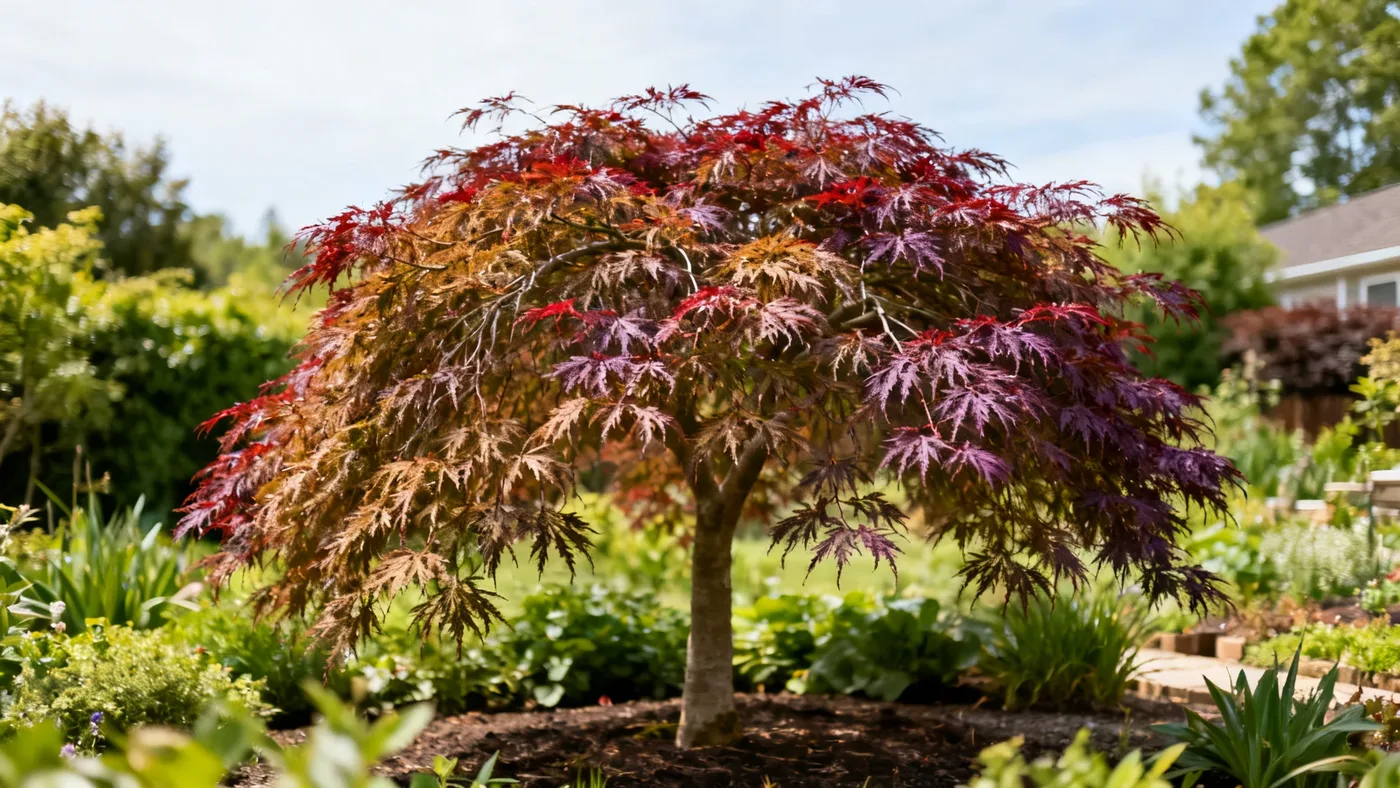
Does Crimson Queen Japanese Maple Tolerate Shade?
Yes, Crimson Queen Japanese Maple tolerates partial shade and can thrive in it, especially in hot-summer climates where afternoon shade actually protects the tree from leaf scorch. But there are conditions: the tree needs good light during part of the day, consistent moisture, and some afternoon protection if you're in a hot region. This guide walks you through assessing your shade situation, planting correctly, and keeping the tree healthy long-term.
Understanding Crimson Queen Japanese Maple Shade Tolerance
Crimson Queen Japanese Maple is rated for full sun to partial shade. The key phrase is partial shade. A tree that sits under dense shade all day won't perform as well as one that gets some direct light, especially in the morning. But a tree that receives afternoon shade in a hot-summer climate can actually thrive better, since the shade prevents leaf scorch and helps maintain that rich crimson color without bronze-green fading.
The plant's small, deeply lobed leaves emerge red-purple in spring and shift toward brilliant crimson to scarlet in fall. In full sun during extreme heat, the foliage may bronze-green slightly. Partial shade, especially afternoon shade, keeps the color deeper and more vivid for longer.
Assessing Your Shade Site Before You Plant
Not all shade is the same. Dappled shade from a taller tree is different from the shade cast by a building. Before planting, spend time observing your site.
Check light patterns throughout the day. Walk your site in the morning (7 to 9 am), midday (11 am to 1 pm), and late afternoon (3 to 5 pm). Note where direct sun hits and where shade falls. Crimson Queen does best with at least 4 hours of indirect or dappled light, or 2 to 3 hours of morning sun plus afternoon shade.
Assess seasonal changes. If you're planting under deciduous trees, remember that the shade picture changes when leaves fall in autumn. Winter sun exposure is less intense anyway, so a spot that feels well-shaded in summer might be fully exposed in winter. This is actually fine for Crimson Queen, which is deciduous.
Consider nearby hardscape. Shade from buildings or solid structures is typically deeper and more consistent than dappled shade from trees. If a building casts the shade, you may need to site the tree closer to its edge to catch some light.
Materials You'll Need
- Crimson Queen Japanese Maple (typically sold in quart, #1, or #3 containers at nurseries)
- Compost or well-rotted organic matter (peat moss, bark mulch, or aged leaf mold)
- Loam-based soil or topsoil (if amending heavy clay)
- Soil acidifier (sulfur) if your soil is above pH 6.5
- Mulch (pine straw, shredded hardwood, or bark, 2 to 3 inches deep)
- Water source and watering can or hose
- Pruning shears (for removing dead or crossing branches after planting)
- Measuring tape (to check spacing)
Step-by-Step: Planting Crimson Queen in Shade
Step 1: Choose the right planting time
Plant in early spring or early fall, when the tree is dormant or transitioning. Avoid peak summer heat, which stresses young, recently planted trees even in shade. Early spring (March to April in zones 5 to 6, earlier in milder zones) or early fall (September to October) gives the roots time to settle before extreme temperatures arrive.
Step 2: Prepare the planting hole
Dig a hole that is as deep as the root ball and 1.5 to 2 times as wide. Do not plant deeper than it was growing in the nursery pot. Japanese maples are sensitive to girdling roots and poor drainage if buried too deep. Loosen the soil at the bottom and sides of the hole to encourage root spread.
Step 3: Amend the soil
Crimson Queen thrives in rich, well-drained loam with a soil pH of 5.5 to 6.5 (slightly acidic to neutral). If your site is heavy clay or alkaline, amend the planting hole and surrounding soil, at least a 3-foot radius.
Mix your native soil with 30 to 50 percent compost or well-rotted organic matter. If pH is above 6.5, add sulfur at the rate recommended on the package to lower it toward 5.5 to 6.5. Work this amendment in thoroughly before planting.
Shade-grown sites often stay wetter, so drainage is critical. If water sits in the planting hole after rain, the tree will rot. Consider mounding the soil slightly above grade or working in extra compost to improve structure.
Step 4: Plant the tree
Remove the tree from its container and gently loosen the root ball by hand. Do not aggressively break up the roots. Set the tree in the hole so the top of the root ball is level with the ground surface. Backfill with your amended soil, pressing gently as you go to eliminate air pockets. Do not tamp hard.
Step 5: Water and mulch
Water the tree immediately and thoroughly to settle the soil. The tree should receive consistent, steady moisture in its first year and beyond.
Apply 2 to 3 inches of organic mulch (pine straw, shredded bark, or leaf mold) around the base, keeping it 2 to 3 inches away from the trunk. Mulch helps shade-grown soil retain moisture and keeps roots cool.
Step 6: Space appropriately
Position the tree 8 to 12 feet from other trees or structures, since Crimson Queen reaches 10 to 12 feet wide at mature spread over 15 to 20 years. Even in shade, the tree will grow to its mature size, just more slowly. A growth rate of 6 to 12 inches per year is typical.
Step 7: Minimal pruning in the first year
After planting, prune only dead, diseased, or crossing branches. Avoid heavy pruning. The tree's natural weeping form is its strongest asset. Let it establish for a year before considering any structural pruning.
Caring for Shade-Grown Crimson Queen
Water consistently. Shade reduces evaporation, so the soil stays moister. But Japanese maple is not drought-tolerant and still needs regular watering. In shade, check soil moisture 2 to 3 inches down before watering. If dry, water deeply. If soggy, let it dry a few days before watering again.
Fertilize sparingly. Apply a balanced, slow-release fertilizer in early spring. Avoid high-nitrogen feeds, which push weak, spindly growth in shade-stressed trees. A light hand is better than heavy feeding.
Prune in late fall to midwinter. Once the tree is established (year 2 or later), prune in dormancy to remove dead interior branches, downward-growing twigs, or crossing limbs that detract from the cascading form. The tree is naturally graceful and rarely needs much work.
Monitor for shade-related pests. Shade can create humid conditions that favor scale insects, aphids, and spider mites. In early season (April to May) and late summer, inspect the undersides of leaves. If you spot webbing, sticky residue, or visible insects, treat with horticultural oil or insecticidal soap, following label directions.
Common Mistakes to Avoid
- Planting too deep. Japanese maple is prone to girdling roots if buried deeper than it was in the nursery container. The tree will slowly decline or dieback if the roots circle the trunk underground.
- Dense, all-day shade. If the tree gets less than 2 hours of any direct light per day, it will become sparse and weak. Dappled shade under deciduous trees works; solid shade from a building may not.
- Soggy soil in shade. Shade plus poor drainage equals root rot. Always amend heavy clay with compost and ensure water doesn't pool around the base.
- Inconsistent watering. Shade-grown trees in moisture-retentive soils are easy to underwater (since you assume they stay wet), but they still need steady water during the growing season. Let the soil guide you, not assumptions.
- Heavy pruning. Cutting back hard destroys the weeping habit that makes this tree special. Remove dead wood and internal branches only.
Expected Results in Shade
A Crimson Queen Japanese Maple planted in partial shade will grow more slowly than one in full sun. You can expect roughly 6 to 12 inches of new growth per year. Over 15 to 20 years, it reaches close to its full mature size of 8 to 10 feet tall and 10 to 12 feet wide, but the timeline may extend slightly in deep shade.
The foliage color may stay deeper crimson for longer in the growing season if the tree receives afternoon shade, especially in hot climates. Leaf scorch, which appears as brown, papery margins in stressed trees, becomes much less likely. Fall color (brilliant crimson to scarlet red) usually develops fully even in partial shade, since it depends more on temperature shifts than light intensity.
The cascading, weeping branch structure becomes more visible as the tree matures and lower interior branches are selectively pruned. In shade, this form is every bit as graceful as in full sun. For a complete overview of this tree's needs and seasonal care, see our Crimson Queen Japanese Maple care guide.
Quick Reference: Shade Planting Checklist
| Task | Timing | Notes |
|---|---|---|
| Assess shade patterns | Before planting (observe 3-5 days) | Aim for 4+ hours indirect light or 2-3 hours morning sun plus afternoon shade |
| Prepare planting hole and amend soil | Planting day | Hole 1.5-2x as wide as root ball; mix native soil with 30-50% compost; target pH 5.5-6.5 |
| Plant tree | Early spring or early fall | Root ball level with ground, no deeper. Space 8-12 ft from other trees |
| Mulch and water | Immediately after planting | 2-3 inches mulch, 2-3 inches from trunk; water deeply |
| Monitor soil moisture | Weekly in first year, then as-needed | Shade reduces evaporation; check 2-3 inches down before watering |
| Light fertilizing | Early spring each year | Balanced, slow-release only; avoid high-nitrogen feeds |
| Pruning (dormant season) | Late fall to midwinter, year 2+ | Remove dead, crossing, and downward-growing branches; keep weeping form intact |
| Check for pests | April-May and late summer | Inspect leaf undersides for scale, aphids, mites; use horticultural oil if needed |
| Expected growth rate | Ongoing | 6-12 inches per year; mature size 8-10 ft tall, 10-12 ft wide over 15-20 years |