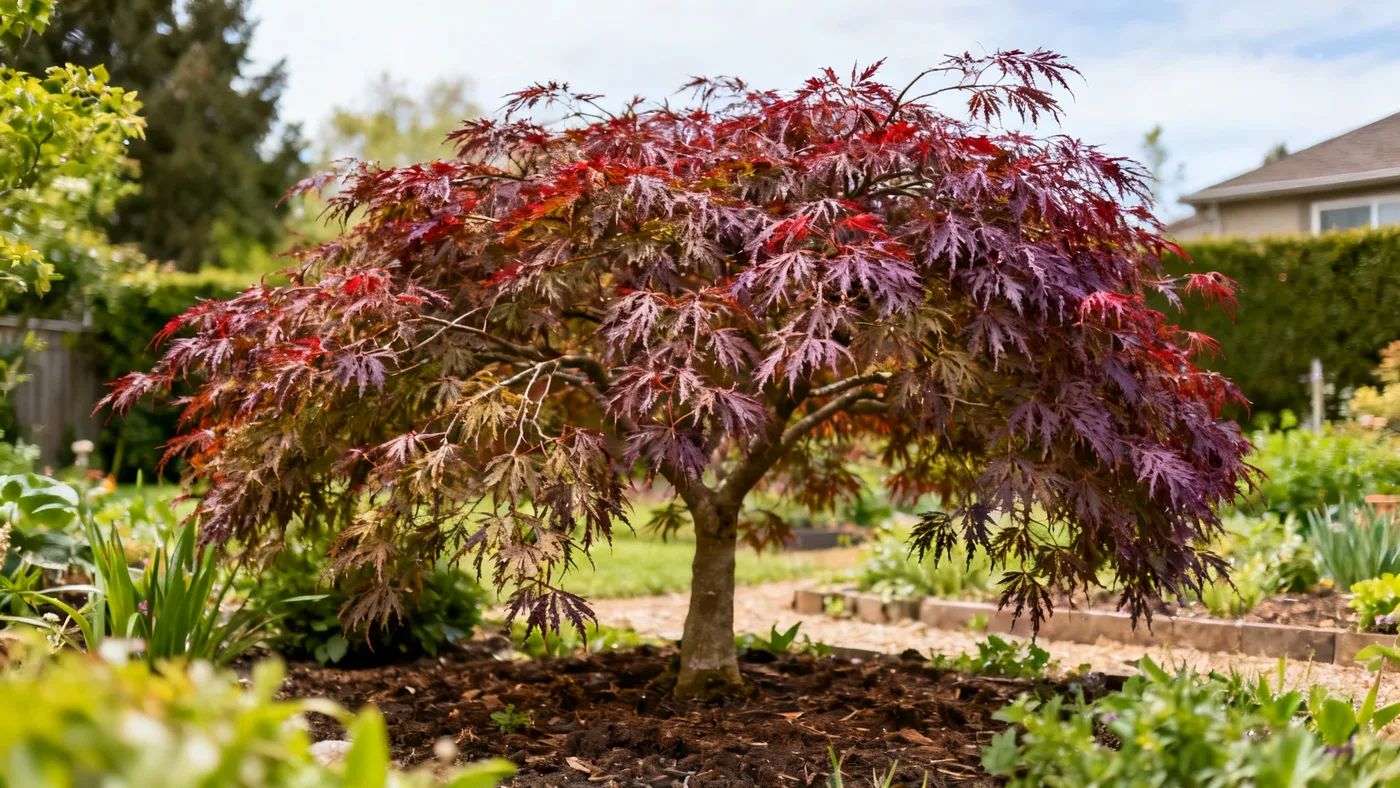
Sun or Shade? Light Needs for Crimson Queen Japanese Maple
Crimson Queen Japanese Maple thrives with the right balance of light and shade. Unlike some ornamentals that demand full sun or require heavy shade, this lacy-leaved cultivar is more flexible, though your climate and specific site conditions determine whether it needs afternoon shade to prevent leaf scorch. This guide walks you through assessing your yard's light conditions and planting Crimson Queen to keep its signature crimson color vibrant year-round.
What Light Does Crimson Queen Japanese Maple Actually Need?
Crimson Queen Japanese Maple grows best in full sun to partial shade. The key is matching the amount of sun to your climate. In zones 5 through 8 with mild summer temperatures, full sun (6 or more hours of direct light daily) brings out the deepest crimson foliage and promotes vigorous growth. In hot-summer regions, afternoon shade becomes essential: it protects the fine lacy leaves from sun scorch and leaf bleaching.
The cultivar's foliage emerges deep red-purple in spring. When grown in full sun in cooler climates, this color intensifies through summer and becomes brilliant crimson to scarlet in fall. In hot climates without afternoon shade, the foliage may bronze or fade greenish as the plant shuts down sun exposure to protect itself. This isn't necessarily a sign of poor health, but it limits the visual appeal many gardeners seek from Crimson Queen.
Afternoon shade means 2 to 4 hours of direct morning or midday sun, with dappled or filtered light in the afternoon (roughly 1 p.m. onward). This balance protects the delicate leaves while still allowing good color development. The Crimson Queen maple light needs are straightforward: more sun in cool zones, more shade in hot ones.
Materials and Resources for Assessing Light
- Notepad or garden journal
- Watch or smartphone timer
- Smartphone camera (to document light patterns at different times)
- Compass or compass app (optional, to identify direction)
- Information about your USDA hardiness zone and typical summer temperatures
How to Assess Your Site's Light Conditions
Step 1: Map the Sun Path Throughout the Day
Visit your planting site at three times: 9 a.m., 12 p.m., and 3 p.m. on a clear day. Note whether the area is in direct sun, dappled shade, or full shade at each time. Pay attention to shadows cast by trees, buildings, or fences. This direct observation tells you far more than a single midday glance. Crimson Queen planted on the east side of a house gets morning sun and afternoon shade naturally. West-facing sites get intense afternoon heat; north-facing sites may be too shaded.
Step 2: Count Total Daily Sun Hours
Add up the hours of direct sun the spot receives. Full sun means 6 or more hours. Partial shade means 3 to 6 hours. Shade means fewer than 3 hours. If your goal is to understand your specific microclimate, take photos from the same spot at each time slot; these become a useful reference.
Step 3: Identify Your Climate Zone and Summer Temperature Pattern
Check your USDA hardiness zone. If you're in zone 5, 6, or 7 with moderate summer temperatures (daytime highs typically below 85°F by mid-August), full sun is safe and encouraged. If you're in zone 8, or if your summers regularly exceed 90°F, afternoon shade for your Crimson Queen is strongly recommended. Does Japanese maple need full sun everywhere? No. Your local heat is the deciding factor.
Step 4: Note Existing Tree Canopy and Future Growth
Look at trees on or near your property. A young deciduous tree on the south side will eventually cast afternoon shade as it matures. This is ideal for Crimson Queen: morning sun, afternoon tree shade. Plan for this maturation; don't expect a newly planted specimen to stay in full sun forever.
Planting Crimson Queen in Full Sun
Full-sun placement works best in cooler zones (5, 6, and 7) and is worth considering in zone 8 only if you can provide consistent moisture and afternoon shade is not available.
- Choose the location: Select a spot that receives at least 6 hours of direct sun daily, with morning sun preferred over afternoon sun. Avoid the hottest west-facing exposures if your summer temperatures regularly exceed 85°F.
- Prepare the soil: Dig a hole as deep as the root ball and twice as wide. Crimson Queen prefers rich, well-drained loam high in organic matter. Amend heavy clay or sandy soil with 2 to 3 inches of compost mixed into the backfill. The soil should be slightly acidic to neutral (pH 5.5 to 6.5).
- Plant at the correct depth: Set the plant so the top of the root ball is level with the ground. Planting too deep is a common error that can cause girdling roots and stunted growth. Backfill and water deeply to settle the soil.
- Mulch and water: Apply 2 to 3 inches of organic mulch (wood chips or shredded bark) around the base, keeping it 6 inches away from the trunk. Water regularly and consistently for the first two growing seasons, especially during dry spells. Crimson Queen is not drought tolerant; it needs regular moisture.
- Monitor for leaf scorch in year one: Even in full sun, newly planted Crimson Queen may show signs of stress if the summer is unusually hot and dry. Watch for browning or bleached leaf edges, especially in mid-to-late summer. If scorch appears, increase watering frequency and consider adding temporary afternoon shade with a shade cloth (30 to 50 percent density) in the hottest weeks.
Planting Crimson Queen in Afternoon Shade
Afternoon shade is the preferred setup in zone 8 and for any garden where summer temperatures regularly exceed 85°F. It's also a good choice if you want to minimize watering needs or if your site has limited full-sun options. Many gardeners find that Japanese maple sun or shade placement comes down to heat management, not light alone.
- Select an east or north-facing location: Plant on the east side of a building or structure so the tree receives morning sun (which is gentler and essential for good color) and afternoon shade. North-facing sites may work but tend to produce softer green-tinted foliage instead of vivid crimson; reserve these for zones 5 to 6 only if you accept slightly muted color.
- Use natural tree shade if possible: Planting Crimson Queen under the filtered canopy of a larger deciduous tree (oak, maple, elm) provides dappled afternoon shade while allowing morning light through. Ensure the larger tree's root system won't starve your Crimson Queen of moisture and nutrients. Space them at least 8 to 12 feet apart.
- Prepare the soil similarly: Follow the same soil preparation steps: dig a hole twice as wide as the root ball, amend with 2 to 3 inches of compost, aim for pH 5.5 to 6.5, and plant at the correct depth (top of root ball level with ground).
- Mulch generously: In shade, the soil dries more slowly, so avoid overwatering. Use 2 to 3 inches of mulch and let the soil dry slightly between waterings. Soggy soil in shade encourages root rot and fungal disease.
- Expect good foliage color: Crimson Queen in afternoon shade typically displays rich red color but may not achieve the most intense crimson of full-sun specimens in cool climates. This is a worthwhile trade-off for avoiding leaf scorch and reducing water stress in hot climates.
Managing Light for Long-Term Health
Once Crimson Queen is established (after 2 to 3 growing seasons), its light needs remain stable, but seasonal and yearly variations matter. Monitor your tree through its first full year. Leaf scorch typically appears as brown or papery edges on the foliage in July or August; if you see it, increase watering or provide afternoon shade in the following year.
As your Crimson Queen matures, it will reach 8 to 10 feet tall and 10 to 12 feet wide over 15 to 20 years. Plan any new plantings or structures with this mature spread in mind; shade cast by nearby trees or buildings may increase over time, gradually shifting a full-sun planting into partial shade. This natural progression is usually beneficial, not harmful.
For more details on year-round care, see our Crimson Queen Japanese Maple Care: The Complete Growing Guide. If you're curious about the tree's mature size and structure, our guide on how big Crimson Queen Japanese Maple gets offers sizing and spacing information.
Common Light-Related Problems and Solutions
| Problem | Likely Cause | Solution |
|---|---|---|
| Brown or papery leaf edges (scorch) | Too much sun + dry soil, especially in heat | Water more frequently; add afternoon shade with a tree or shade cloth; move tree if possible |
| Foliage fading to bronze-green in summer | Heat stress from full afternoon sun in zone 8+ | This is normal, not a disease. Provide afternoon shade next season if color matters to you |
| Pale or weak foliage color | Too much shade (fewer than 3 hours direct sun) | Remove competing shade; thin branches of overhead trees; move to a sunnier spot if possible |
| Leggy, thin growth | Insufficient light | Gradually increase sun exposure; thin branches of overhead trees; prune to encourage branching once light improves |
| Root rot or fungal disease despite adequate light | Poor drainage; excess soil moisture in shade | Improve drainage by amending soil with compost; reduce mulch thickness if sodden; ensure air circulation |
Quick Reference: Light Needs Checklist
- Ideal light: Full sun to partial shade (6 hours direct sun daily in cool climates; 3 to 6 hours with afternoon shade in hot zones)
- Zones 5 to 7: Full sun acceptable and encouraged for best color
- Zone 8: Afternoon shade strongly recommended
- Zone 9: Attempt only with afternoon shade
- After planting: Monitor for leaf scorch in year one, especially mid-to-late summer
- Soil moisture: Keep soil consistently moist but not waterlogged, regardless of light level
- Expected result: Deep crimson foliage in full sun (cool zones); vibrant red color maintained with afternoon shade (hot zones); graceful, weeping form visible year-round
- Growth rate: Slow growth (6 to 12 inches per year); full mature size reached in 15 to 20 years
- Spacing: Plant 8 to 12 feet from other trees or structures given mature spread