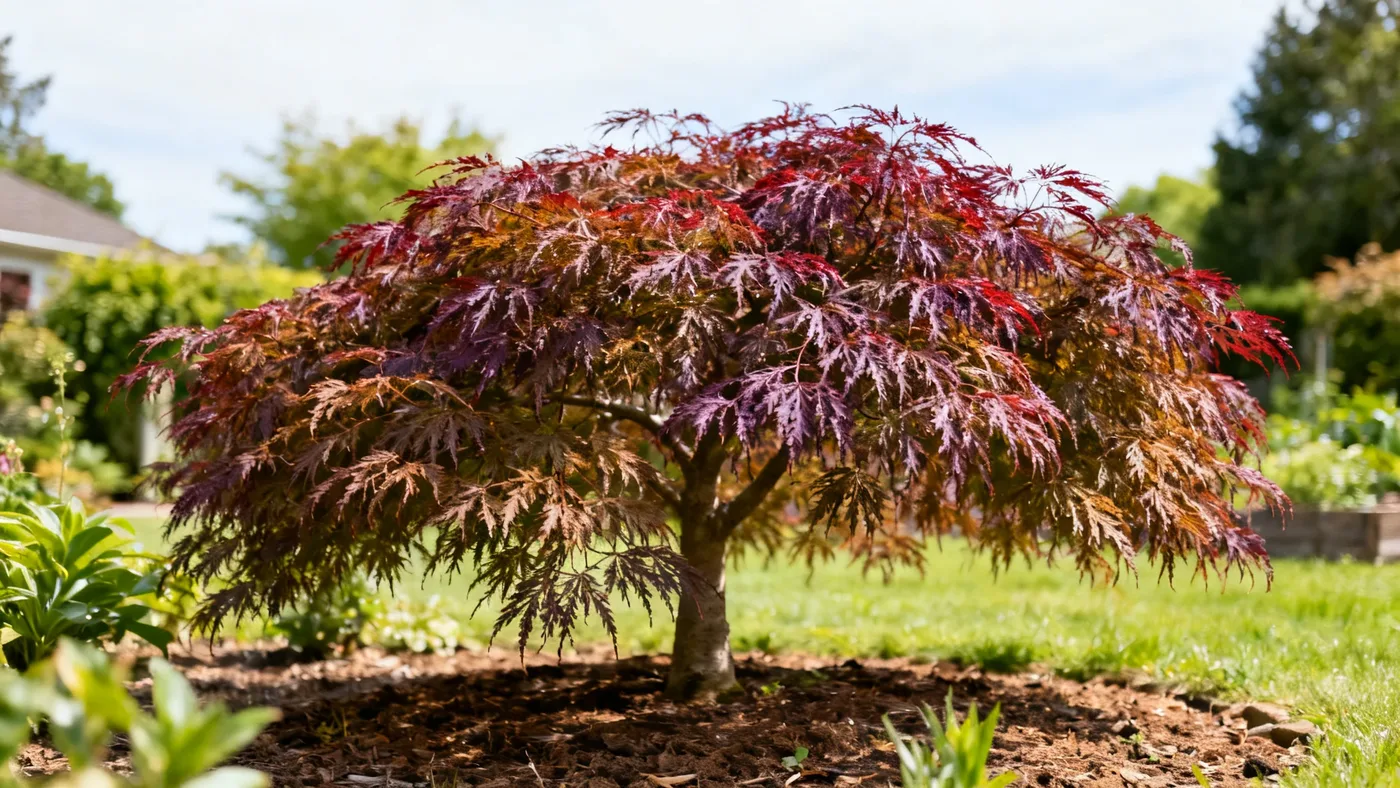
Is Crimson Queen Japanese Maple Toxic to Dogs, Cats or People?
If you are planning to add a Crimson Queen Japanese Maple to a garden where pets or small children spend time, it is natural to ask about safety. This guide covers what we know about the toxicity of this elegant weeping tree, addresses common concerns, and explains what precautions make sense for a pet-friendly or child-friendly landscape.
General Toxicity Status
Is Crimson Queen Japanese Maple toxic to dogs, cats, or people?
Crimson Queen Japanese Maple is not known to be toxic to dogs, cats, horses, or people. The plant has no documented history of causing poisoning in pets or humans, and it is not listed on standard veterinary or poison control toxicity databases as a concern. This status applies specifically to the Crimson Queen cultivar and the parent species Acer palmatum.
What do veterinarians say about Japanese maples?
Most veterinarians do not list Japanese maple as a concern in pet-friendly gardens. If a vet raises a question, it is often out of an abundance of caution or based on confusion with other plants. You can reference the plant's absence from ASPCA and Pet Poison Helpline databases of toxic plants when discussing it with your veterinarian.
Why do some people think Japanese maples are toxic?
The concern sometimes arises because Japanese maple is occasionally confused with other maples, particularly Norway maple or red maple, which can cause toxicity in some animals under certain conditions. Additionally, ornamental plants in general carry a default assumption of "check first" in pet-owner conversations, even when a specific plant is safe. The lacy, delicate appearance of Crimson Queen may also lead people to assume it must be fragile or harmful.
Are there any parts of Crimson Queen maple that are toxic?
No parts of the Crimson Queen maple, including the leaves, bark, seeds, or flowers, are known to be toxic. The plant is safe throughout its structure and at all stages of growth.
Dogs and Crimson Queen Maple
Is Crimson Queen Japanese Maple toxic to dogs?
No. Crimson Queen Japanese Maple is not toxic to dogs. The plant does not appear on veterinary toxicity lists, and there are no documented cases of poisoning in dogs from ingesting Japanese maple leaves, bark, or seeds. You can safely plant this tree in a garden where dogs have access.
What should I do if my dog eats Japanese maple leaves?
In most cases, a dog eating a small amount of Japanese maple leaves will have no ill effects. If your dog consumes a large quantity of leaves or shows signs of gastrointestinal upset (vomiting, diarrhea, loss of appetite), contact your veterinarian. While this is unlikely to be caused by the maple itself, a vet visit will rule out other issues and provide reassurance.
Can I plant Crimson Queen maple near a dog run or in a fenced yard where dogs play?
Yes. The plant is safe around dogs. Keep in mind that a young Crimson Queen grows slowly, roughly 6 to 12 inches per year, and reaches 8 to 10 feet tall and 10 to 12 feet wide over 15 to 20 years. In a high-traffic dog area, the tree may benefit from protective fencing during its first few years to allow the root system to establish without trampling or digging around the base.
Should I worry if a puppy chews on the bark?
Occasional chewing on bark is not a toxicity concern. Young or teething puppies may gnaw on plant stems out of curiosity or to soothe their gums. Redirect the puppy to appropriate chew toys. If chewing is extensive, a small protective guard or fence around the tree base can help during the puppy stage.
Cats and Crimson Queen Maple
Is Crimson Queen Japanese Maple toxic to cats?
No. Crimson Queen Japanese Maple is not toxic to cats. While outdoor cats may occasionally nibble on ornamental plants, this particular maple poses no toxicity risk. Cats are less likely than dogs to eat foliage in large quantities, but the plant is safe regardless.
Is it safe to have Crimson Queen maple near a catio or outdoor cat enclosure?
Yes. The tree is completely safe for cats. If you are designing an enclosed space for cats, Crimson Queen maple provides dappled shade and visual interest without any toxicity concern. The cascading branch structure may even provide cats with climbing or resting spots, depending on how you structure the space.
Children and People
Is Japanese maple poisonous to children?
No. Japanese maple, including Crimson Queen, is not poisonous to children. The plant is safe if a child touches, brushes against, or even ingests a small amount of foliage. It is not an irritant to skin or eyes, and no toxins are present in any part of the tree.
What should I do if a child swallows Japanese maple leaves?
In most cases, no action is needed. A child who swallows a small handful of leaves is unlikely to experience any effects. If a child ingests a very large quantity or shows signs of gastrointestinal upset, contact Poison Control at 1-800-222-1222 (in the United States) to speak with a specialist. Poison Control has no record of Japanese maple toxicity but will help you assess the specific situation.
Can I plant Crimson Queen maple in a family garden with young children?
Yes. The tree is safe in family gardens. The only consideration is the tree's graceful, weeping habit and size at maturity (8 to 10 feet tall and 10 to 12 feet wide). Position it where low-hanging branches will not obstruct pathways or create a tripping hazard for small children, particularly in shaded areas.
Is Crimson Queen maple safe to handle without gloves?
Yes. You can safely handle, prune, and maintain the tree without gloves. The leaves, bark, and stems are not irritating to skin. Standard gardening gloves are optional and chosen for comfort or blister prevention, not for protection from the plant itself.
Plant Parts and Potential Confusion
Are Japanese maple seeds (helicopters) harmful if swallowed?
No. Japanese maple seeds are not toxic. The papery winged seed pods (often called helicopters or samaras) are harmless if ingested. Children may pick them off the tree and play with them without risk.
What about the small spring flowers? Are they safe?
Yes. Crimson Queen produces small reddish-purple flowers in spring (April to May) that are not ornamentally significant and are completely safe. Neither the flowers nor any nectar are toxic to bees, butterflies, or other wildlife, or to people who might come in contact with them.
Why is my plant sometimes confused with maple trees that are toxic?
Red maple (Acer rubrum) can cause toxicity in horses under certain conditions, particularly if large quantities of wilted leaves are ingested. Your Crimson Queen is a completely different species (Acer palmatum var. dissectum) and carries no such concern. Ensuring you have the correct cultivar label when you purchase the plant will eliminate any confusion.
Garden Safety and Best Practices
How should I position Crimson Queen maple in a pet-friendly garden?
Plant Crimson Queen in a location where it receives full sun to partial shade and has regular, consistent moisture. Position the tree where its mature spread (10 to 12 feet) will not crowd other plants or structures. While the tree is safe for pets, adequate spacing allows both the tree and your pets to thrive without competition for resources.
Should I use any barriers or fencing around the tree?
No toxicity-related barrier is necessary. In high-traffic pet areas or during the tree's first few years while roots are establishing, a temporary fence (2 to 3 feet around the base) can protect the tree from trampling or digging. This is about tree health and root development, not safety.
Are there safer tree alternatives I should consider instead?
Crimson Queen Japanese Maple is already among the safest ornamental trees for mixed gardens with pets and children. If you want a comparison, other safe options include crabapples, serviceberries, and non-toxic shade trees. However, no safety upgrade is needed if you prefer Crimson Queen's distinctive weeping form and foliage color.
What To Do In Case of Ingestion
What should I do if my pet ingests a large amount of Japanese maple foliage?
Contact your veterinarian or Pet Poison Helpline (888-426-4435) for professional guidance. While toxicity is not a concern, a vet can rule out other issues or treat any gastrointestinal upset. Have information ready: the species of plant (Acer palmatum var. dissectum, Crimson Queen), the approximate amount ingested, and the time it occurred.
Should I call Poison Control if a child swallows Japanese maple?
If a child ingests a small amount, monitoring at home is typically sufficient. If the amount is very large, the child shows any signs of distress, or you want professional reassurance, call Poison Control at 1-800-222-1222. The specialist can confirm that Japanese maple is safe and advise you based on the specific situation.
What symptoms would indicate a toxicity problem (even though none are expected)?
Since Japanese maple is not toxic, symptoms are not expected. If a pet or child shows vomiting, diarrhea, lethargy, or loss of appetite after ingesting plant material, those symptoms would point to something other than the maple itself. A veterinarian can investigate the actual cause and provide appropriate care.
Quick Reference: Crimson Queen Maple Safety Checklist
| Question | Answer |
|---|---|
| Toxic to dogs? | No |
| Toxic to cats? | No |
| Toxic to people? | No |
| Toxic leaves, bark, or seeds? | No |
| Skin irritant? | No |
| Safe to handle without gloves? | Yes |
| Safe around horses? | Yes |
| Safe in family gardens? | Yes |
| Safe near pet play areas? | Yes |
| Need protective barriers for safety? | No |
Learn More About Growing Crimson Queen
If you are planting Crimson Queen Japanese Maple in your garden, toxicity is not a concern for pets or children. For detailed guidance on planting, spacing, watering, and seasonal care, see the complete growing guide for Crimson Queen Japanese Maple. That resource covers all the horticultural details you'll need to help this beautiful tree thrive.