Crimson Queen vs Crimson King Maple: Two Very Different Trees
Picture someone who wants a weeping, lace-leaved accent beside the front door. They search for a crimson maple, find the name Crimson King, and order it in their mind's eye: a low red cascade at the doorstep. What they have actually pictured is a large shade tree that would one day fill the whole front yard with canopy.
The mix-up is easy to make, because Crimson Queen and Crimson King share a color word, a genus and a dark red leaf, and little else. Get it wrong and you end up with a tree that outgrows its spot, or one that never gives the shade you wanted.
In this article, we'll go through the names, the leaves, mature size, light, hardiness and the landscape role of each tree, so you can be sure which one you are buying.
Crimson Queen Japanese Maple Is Not a Norway Maple
The two names sound like a royal pair, and that is the trap. They are separate species that happen to share a genus and a dark red leaf.
Reading the Botanical Names
Botanical names do the sorting for us, so it pays to read the two labels slowly.
Crimson Queen is Acer palmatum var. dissectum 'Crimson Queen'. Acer is the maple genus, palmatum is the Japanese maple, and dissectum marks the finely cut, weeping group. The part in quotation marks is the cultivar name, a selection named and released in 1965.
The species itself is native to southeast Korea and central and south Japan, which is a long way from the Norway maple's story.
Crimson King is Acer platanoides 'Crimson King', a Norway maple. Same genus, different species, the way two cousins share a surname without sharing a house. "Queen" and "King" are only cultivar names. They tell you nothing about size, habit or relationship.
Where Red Maple Muddies the Name
A third name keeps turning up in searches, and it makes the confusion worse.
Shoppers type "crimson queen red maple" and "is Crimson King a red maple" often enough that we answer it directly. Red maple is yet another species, Acer rubrum, and neither of these trees is one. Here "red" describes leaf color, not ancestry. One of the most common questions we get is whether Crimson King is a red maple. It is not. It is a Norway maple.
Ignore the common name and read the Latin on the tag. If it says platanoides, you are buying a large shade tree. If it says palmatum and dissectum, you are buying the small weeping one.
Crimson Queen Japanese Maple Leaves Next to Crimson King
Put one leaf from each tree in your palm and the confusion ends. One is a feather, the other a hand.
Lace Versus Broad Lobes
Start with the shape of the leaf, since that is what you notice from the sidewalk.
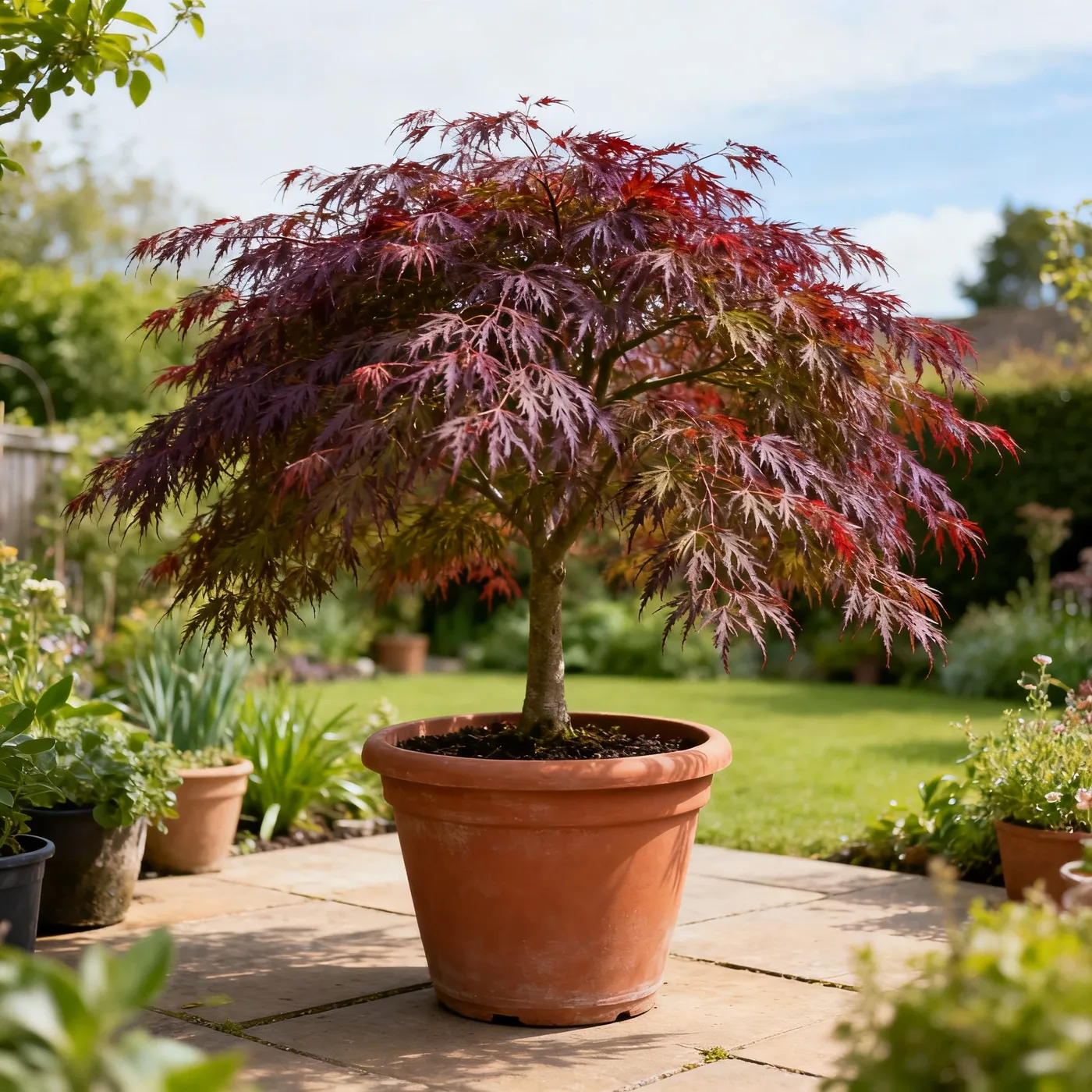
Crimson Queen leaves are divided into 7 to 9 narrow, deeply incised lobes, and they unfold crimson-red and very lacy in texture. Each leaf is more cut than leaf. Light passes straight through, and the whole mound shimmers in the slightest air.
Crimson King carries the broad, lobed leaf of a Norway maple, a solid surface with little cutting. Seen as a whole, the foliage reads as one dark, heavy mass, closer to a velvet drape than a lace curtain.
The flowers differ too. The Crimson King crown fills with maroon and yellow flowers in spring, high overhead. Crimson Queen offers only small purple ones that sit among the new leaves and are easy to miss.
How the Color Moves Through the Year
Color is the other half of the resemblance, and here the two trees behave differently.
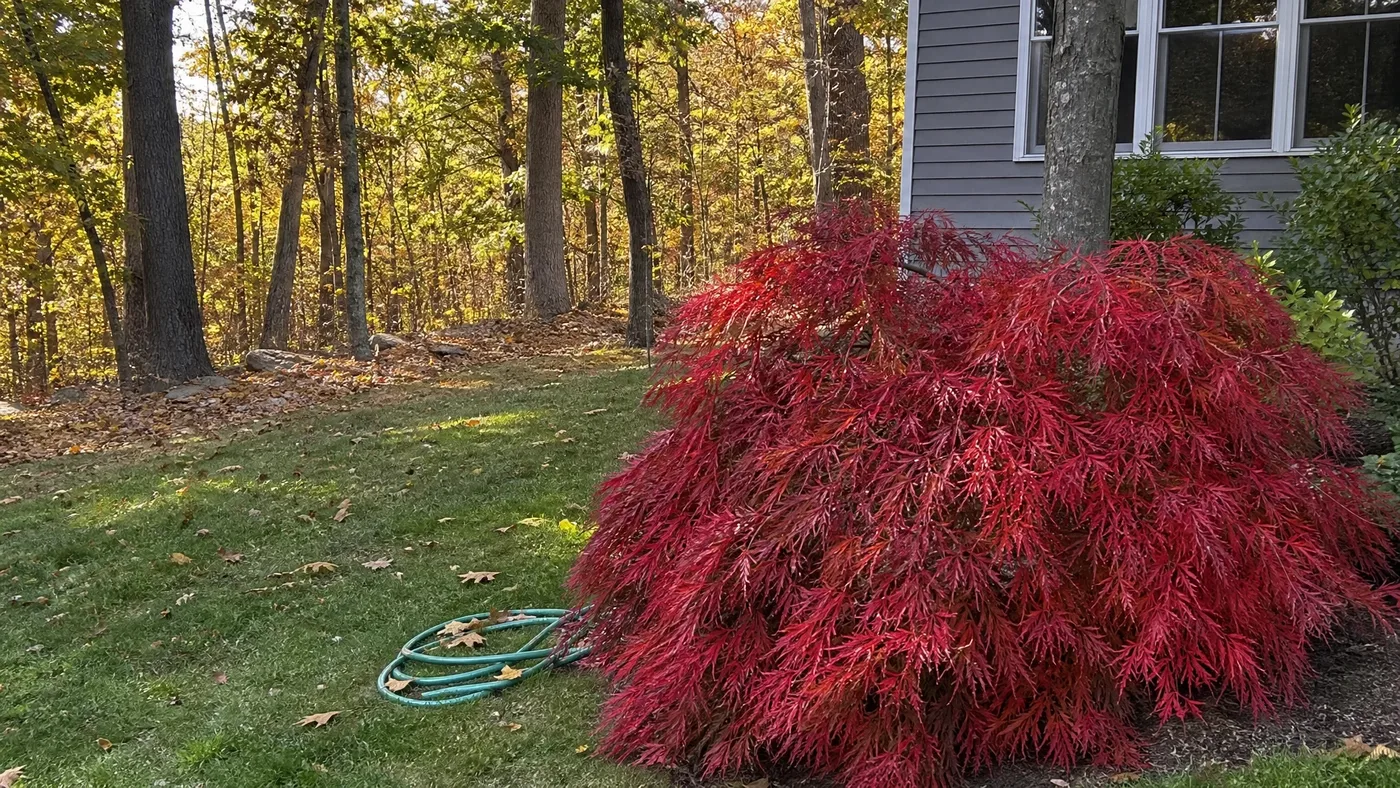
Crimson Queen opens crimson-red and settles to a deep reddish-purple. The burgundy foliage retains its color all summer and turns scarlet in fall. In our rows, a block of Queens in the first weeks of spring looks like a spill of red thread.
A Crimson King reads quite differently from a distance. Its leaves form a dark canopy that looks like shadow more than color, and it never shows the glow of a small, backlit weeping tree. If you want the lace and the scarlet fall, only one of the two can give it to you.
Because Crimson Queen sits at eye level, you also see the color up close: the veins, the cut edges, the way a low evening sun turns the mound translucent. A canopy forty feet up gives you none of that detail.
A Mound Under Windows, a Giant Over the Lawn
Size is where the two names part ways most sharply. Think of the silhouette each one makes against your house.
Height, Spread and Shape in Figures
The table below sets the trees against each other, using figures from the university and arboretum sources we trust.
| Feature | Crimson Queen | Crimson King |
|---|---|---|
| Species | Acer palmatum var. dissectum | Acer platanoides |
| Mature height | About 5–8 ft, up to 10 ft | 35–45 ft |
| Mature spread | About 5–8 ft, to slightly wider than tall | 25–30 ft, up to 40 ft |
| Shape | Dense, compact weeping mound | Oval to rounded crown |
Crimson Queen grows to only 10 feet tall and slightly wider, reaching 5 to 8 feet in 10 to 20 years. By comparison, Crimson King grows to 35 to 45 feet, spreading about 25 to 30 feet.
What That Does to a Planting Spot
Those numbers decide where a tree can stand without a fight.
A Crimson Queen is slow to moderate in growth, and its mound stays low enough to sit under a window or beside the steps. You can plan around it for decades without a saw. The habit is dense and compact, which is why the shape holds so well beside a doorway.
A Crimson King needs room for a trunk, a wide crown and a root system, well away from the house, paving and wires. Our guide on how big a Crimson Queen gets covers the small tree's growth year by year.
Light Beneath the Canopy of Each Tree
Light works in two directions here: the shade each tree throws, and the sun each tree wants.
What Each Tree Throws on the Ground
Underneath the two trees you will find completely different gardens.
A Crimson Queen casts a small pool of shade, mostly on itself, so low plants can sit right to the edge of its mound. A mature Crimson King puts a broad, dense umbrella over a whole section of lawn, and turf and sun-loving perennials beneath it tend to thin out. One shades a patch of ground, the other shades a yard.
What Each Tree Asks of the Sun
The small tree is the fussier of the two about where it stands.
Crimson Queen suits full sun to part shade. Leaf scorch is a known problem for the species, and that is why we suggest morning sun with afternoon shade wherever summers are hot and dry. Reflected heat from a wall or paving makes it worse, because the mound sits right at that level.
Scorch shows first on the finest leaves at the outer edge, where they dry and curl. The tree is not dead, but it looks tired for the rest of the season, and the fix is a better site, not more water.
A Crimson King sits high above the ground and has none of that exposure. Our light needs guide for Crimson Queen walks through the siting choices for the small tree.
Cold Tolerance Compared for Crimson Queen Japanese Maple
If you garden in a cold zone, this is the section that may settle the question for you.
The Zone Numbers
The two trees cover overlapping but different ranges.
UF/IFAS lists Crimson King for USDA zones 3B through 7B, and NC State rates the Japanese maple species from 5a to 8b. In plain terms, the Norway maple goes colder by a couple of zones. The Japanese maple reaches further into the warm end of the map.
Our hardiness zones guide goes deeper on how to read these ratings for your yard.
How Each Behaves Through Winter
A hardiness number says whether a tree survives, which is not the same as whether it looks good.
NC State lists frost damage, especially from late frosts, as a risk for Japanese maples. Crimson Queen's new crimson leaves are the tender part. On the cold end of its range, we advise a spot sheltered from wind and away from low pockets where cold air settles. Crimson King, with its wider range, rarely needs that care.
If you garden in zone 3 or 4, Crimson Queen is a gamble and we would not push it. Pick the tree the climate favors, and keep a small Japanese maple for the zones it was rated for.
Where Each Tree Belongs in a Landscape
Seen as a design question, the trees do different jobs. One makes a moment, the other makes a room.
Crimson Queen at the Entry
The small tree earns its place by being looked at closely.
Crimson Queen is an accent plant. It suits an entry bed, a corner of a patio, the curve of a path or a gap in a foundation planting where you want one clear point of interest. Its red lace stands out against evergreens or pale stone, and its cascading outline softens a hard corner of a step or wall. For combinations that work, see our landscape ideas and companion plants.
Crimson King Along the Street
The large tree works at a very different distance.
Crimson King is a street or shade tree. It suits a large lot with open space, where its crown can spread. It also comes with a caution. UF/IFAS classes it as an invasive non-native, so check with your local extension service before planting it. Where a Norway maple is discouraged or restricted, the small, well-behaved Crimson Queen may be the only tree of the pair you can plant at all.
Choosing Crimson Queen Japanese Maple Over a Shade Tree
Before you place an order, run a few checks that guarantee the small weeping tree is the one that arrives.
Checklist Before You Order
These checks take two minutes and prevent the mistake this guide is about.
- Read the full botanical name on the listing or the tag: it should say Acer palmatum var. dissectum 'Crimson Queen'.
- Look at the photo of the plant itself, which should show a cascading, mounding habit and finely cut leaves.
- Check the mature size in the description. A listing that promises 35 feet or more is a different tree.
- Ask what pot size you are getting. Our buying guide explains what to look for.
Which One We Would Choose
Our answer depends on the property, and we will be plain about it.
For nearly every home garden, we would choose Crimson Queen. It fits the spaces most people actually have and gives lace in summer and scarlet in fall. We would pick Crimson King only for a very large site in a cold zone where a big shade tree is the goal, after checking the invasive status locally. We grow Crimson Queen as a young, already weeping plant, so you can see the habit before you plant.
Two Trees at Dusk, One Right for Your Door
Crimson Queen is a small, slow, weeping Japanese maple of about 5 to 10 feet. Crimson King is a Norway maple that grows to 35 to 45 feet. They share a color word and nothing else that matters, so read the Latin name, check the mature size, and match the tree to the space and the climate you actually have.
Crimson Queen Japanese Maple
Nursery-grown Crimson Queen Japanese Maple in sizes from 1 Gallon, shipped to your door.
From $59.97
Shop Now →Think of the two at dusk: one a low silhouette beside the door, rounded and tumbling, the other a towering canopy darkening the sky above the lawn. Customers come back to us for Crimson Queen because we grow it ourselves on our own farms, and it arrives as the small, lace-leaved tree they pictured.