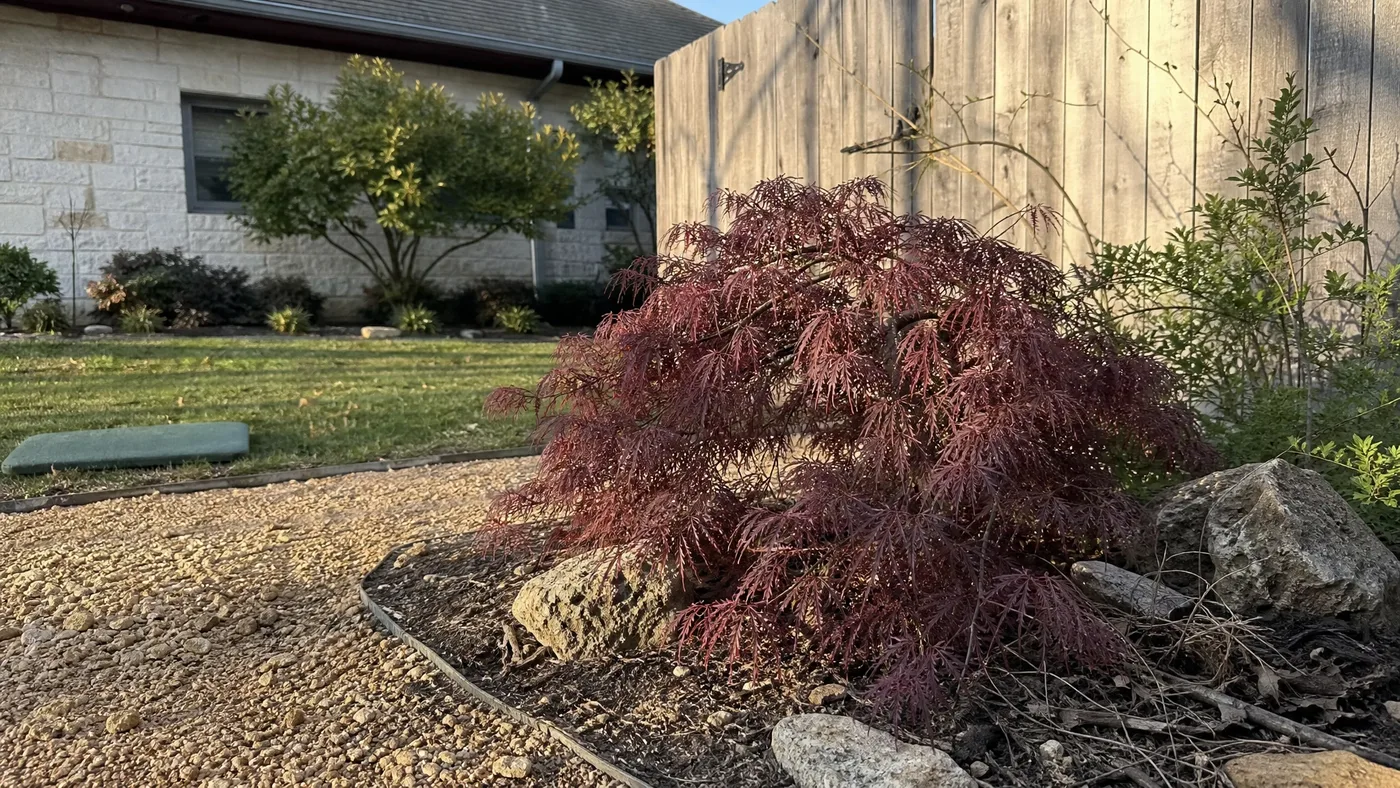
How Fast Does Crimson Queen Japanese Maple Grow Each Year?
Your Crimson Queen will not impress you in its first summer, and that is normal. You will plant a small, lacy, purple-red tree, water it faithfully, and by September it will look almost exactly as it did in the pot. Most people expect a shrub that fills its spot in two seasons. This is a slow weeping mound, and the plants that disappoint in year one are usually the ones doing everything right.
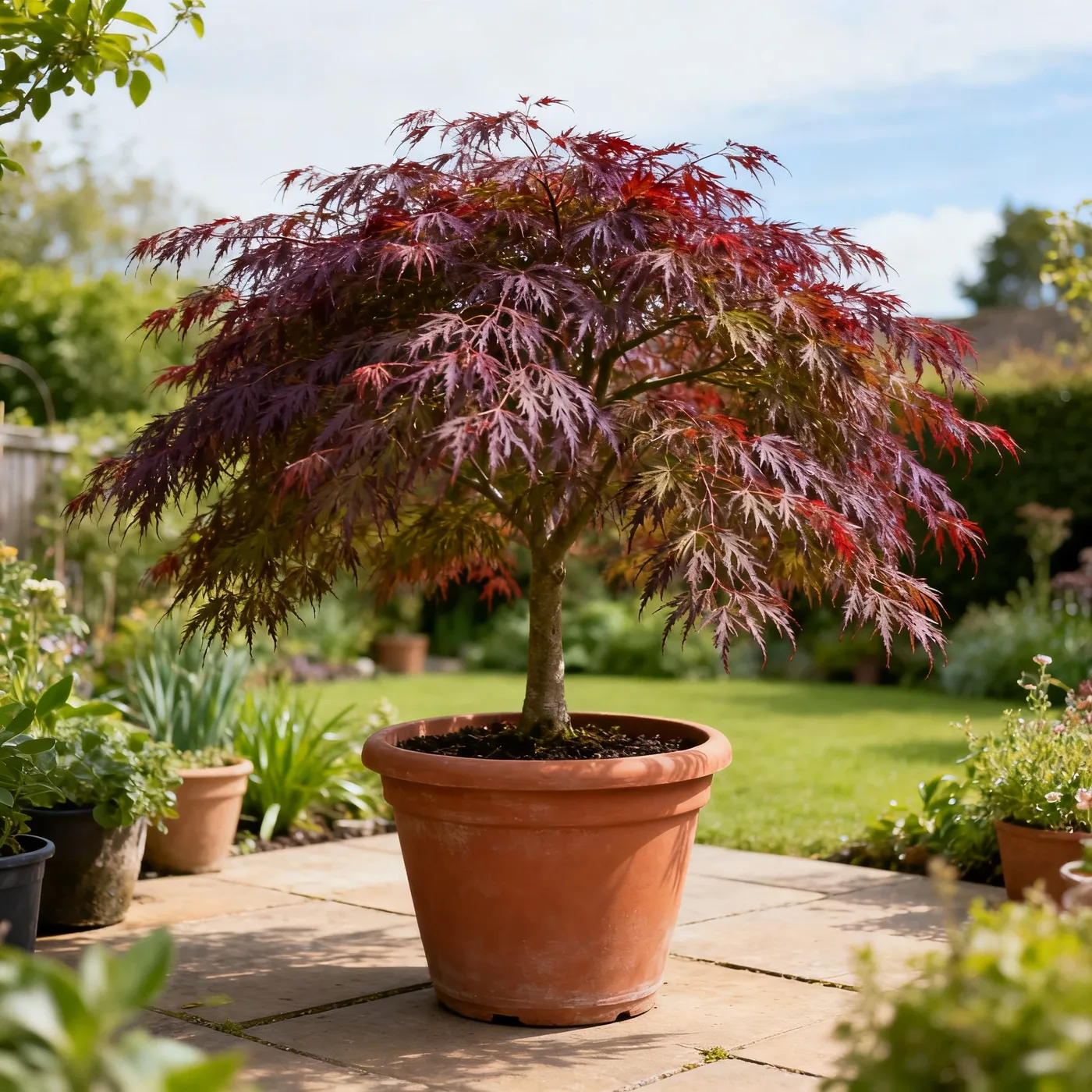
This guide covers everything you need to know about how fast Crimson Queen grows, from choosing a pot size and getting through the first weeks to the early building years, the factors that speed it up or stall it, and the finished mound. Slow growth is not a flaw to fix. A tree that gets the basics right ends up as a dense, layered mound that is worth the wait.
Buying a Crimson Queen Japanese Maple by Pot Size
The pot you buy sets your starting line, so settle it before anything else. Here is what each common size starts you with.
What a #1 Pot Starts You With
The smaller container is the one most people reach for first, and it has real advantages.
A #1 pot holds a young plant with a small root system and a modest crown of branches. It costs less, it is easy to carry and plant, and it settles in quickly because there is little root mass to reestablish. What it does not give you is time. Everything the tree will become still lies ahead, and the clock starts the day it goes in the ground.
What a #3 Pot Starts You With
The larger container changes the timeline more than most buyers expect.
A #3 pot holds a plant that has already spent extra seasons in the nursery. It arrives with more branch structure and a bigger root ball, so it looks like a small Crimson Queen rather than a promise of one. That head start is the only way to buy years, because nothing you do after planting speeds this tree up by much.
Which Pot Fits Your Patience
Here is what we tell customers, plainly.
If you want the shape sooner, buy the larger pot and accept the extra weight. If you are patient and watching the budget, a well-planted #1 will establish easily, though it will trail the bigger plant for a long time. Our guide to Crimson Queen pot sizes and what to look for covers the inspection side, and the root check later in this guide matters more than the number on the label.
The First Few Weeks After Planting
Expect very little to happen above ground right after planting. That quiet stretch is transplant shock, and it is the tree doing its job.
What You Will See
The first weeks tend to worry people more than any other period.
New leaves may stay small, the canopy may look a little tired, and a few leaf tips can brown. The tree is repairing roots that were cut or crowded when it left the pot, and it spends its energy underground first. Do not read stillness as failure. A Crimson Queen that holds its leaves and shows no new damage is doing fine, even if it adds nothing you can measure.
What Helps and What Hurts
Your job in this stretch is to remove stress, not to add effort.
Planting at the right depth and in the right place does more than any product, and our guide on how to plant a Crimson Queen the right way walks through it. Keep the root zone evenly moist, since the plant has few roots to find water with. Skip the fertilizer, skip the pruning, and resist digging it up to look. Shade from hot afternoon sun is a kindness while it recovers.
Young leaves of the species are sensitive to frost and are not drought tolerant, so a late cold snap or a dry week hits a new transplant harder than it hits an established tree. Cover it on a frosty night and check the soil by hand rather than by calendar.
Year One Is Mostly Roots for Crimson Queen Japanese Maple
By the end of the first growing season, you will have a tree that is only a little bigger and a root system that is much bigger. That is the right trade.
Roots Before Branches
A newly planted tree has to anchor itself and reach moisture before it can afford to spread its branches.
The roots leave the old pot shape and push into the surrounding soil, and that work takes the whole season. One of the most common questions we get is why a tree that was watered every week made no visible progress. The answer is that the progress happened where you cannot see it. Rushing the top with extra feeding would only give you a bigger canopy sitting on a weak root system.
What the Top Does in Year One
Above ground, expect modest extension on the branch tips and a mound that looks much as it did in the pot.
The leaves unfold crimson-red and very lacy, and you will enjoy the color long before you see any size. Do not judge the tree by height in the first year. Judge it by whether the leaves stay healthy through summer and whether the buds break evenly the following spring. If they do, the tree is on schedule.
Crimson Queen Japanese Maple in Years Two to Five
This is where the tree starts to behave like a plant with a plan. Growth stays slow, but you can finally see it from one year to the next.
Years Two and Three
With the roots settled, the branches begin to lengthen and arch outward.
The species grows slowly to moderately, and Crimson Queen sits at the slow end of that range. You will notice the cascading habit taking hold, with branches drooping under their own weight and layering over each other. Gains are small, more a matter of the mound getting fuller than taller. Take a photo from the same spot each autumn, because you will not see the change by looking at it daily.
Years Four and Five
By now a healthy plant is visibly a mound rather than a sapling.
The branches have enough length to drape, the interior thickens, and the tree begins to fill the space you gave it. This is also when mistakes in spacing show up, so check how much room is left against the figures in our guide on how big a Crimson Queen gets. A tree that grew from a #3 pot will be well ahead of one from a #1, and that gap tends to persist.
What Speeds Up or Stalls Crimson Queen Japanese Maple
You cannot make this tree fast, but you can easily make it slower. Four things matter most: light, water, soil and feeding.
Sun and Wind
Light is the factor people get backwards.
The cultivar suits full sun to part shade, but in practice a hot, windy site is the main thing that stalls growth. NC State notes that Japanese maples may suffer leaf scorch with excess sun, wind or drought. A scorched canopy loses leaf area, and with it the energy to grow. Afternoon shade and shelter from drying wind keep the leaves working all season.
Water and Soil
Steady moisture beats generous but irregular watering.
The soil should be moist but well-drained, with an acid or neutral pH. Heavy, soggy ground suffocates the fine roots, while sandy, fast-draining ground leaves the tree dry between waterings. Both stall growth. The principle is even moisture without standing water, and a mulch layer kept off the trunk helps hold that balance through a dry summer.
Feeding
Many people reach for fertilizer to speed things up, and with this tree it rarely works.
Heavy nitrogen pushes soft, fast growth that is more prone to scorch and tip damage, and it does not change the plant's slow nature. A light hand is better, and our piece on whether Crimson Queen needs fertilizer explains when feeding helps. Good soil and consistent water give you more than any bag will.
Root-Bound Pots Cost Your Crimson Queen Japanese Maple a Year
A tree that has been in its container too long can lose a full season or more after planting. Catching it at purchase is far cheaper than fixing it later.
Why Circling Roots Delay Everything
Roots that have wrapped the inside of a pot keep wrapping after planting.
Instead of reaching outward into the soil, they continue in circles and the tree never builds the wide anchor it needs. The top may look fine for a year or two, then the plant stalls, leans or struggles in summer heat. We often see this in trees that were bought on looks and never checked below the soil line. The delay is real, and it is entirely avoidable.
How to Spot One at Purchase
A few quick checks will tell you most of what you need to know.
- Lift the pot and look at the drainage holes, because thick roots poking out of them are a warning sign.
- Slide the plant partway out if the seller allows it, and look for a solid mat of roots with little visible soil.
- Check that the trunk meets the soil cleanly and the plant does not rock loosely in the pot.
- Run your thumbs over the surface for roots circling the top of the root ball.
If you do end up with a tight root ball, loosen or tease the outer roots gently at planting so they have a direction to grow in.
An Established Crimson Queen Japanese Maple at Full Mound
Once the tree has built its framework, growth slows further and the size you see is close to the size you keep.
How Big the Mound Gets
Sources vary a little, and it is worth knowing the range.
The cultivar is a slow-growing, shrubby mound eventually reaching nine feet high. Another range is 1.5 to 2.5 meters, about 5 to 8 feet, for both height and spread, with 10 to 20 years to maturity. Plan for the upper end if you have the room, and for the lower end if your site is dry or exposed.
The Slow Pace of Established Growth
A mature plant adds very little each year, and that is a feature.
In our rows, an older Crimson Queen rarely surprises anyone. It thickens, its branch tips extend a little, and the canopy gets heavier and more layered. This is also why pruning should be restrained. The tree is already shaped, and our guide to pruning Crimson Queen without ruining the shape explains how to remove only what is dead or crossing.
Patience Pays Off With Crimson Queen Japanese Maple by Year Ten
Put the stages together and the timeline is simple. Each phase asks something different of you, and none of them asks for speed.
In the first year, you get roots and not much else. In years two and three, the branches lengthen and begin to arch. By years four and five, you have a recognizable mound. Somewhere around year ten, a tree started from a healthy pot and given decent conditions usually looks like a finished plant, with a dense, layered form that holds its shape through the seasons.
It will keep growing slowly after that, and the cultivar tops out at about 10 feet tall and slightly wider as an upper bound. Rushing any stage costs you more than it saves. Good siting, even moisture and a sound root system are what get you there.
Plant Your Crimson Queen Japanese Maple Early
Crimson Queen grows slowly at every stage, and most of what looks like a problem in the early years is the tree behaving normally. Buy a pot size that matches your patience, check the roots, protect it from hot sun and wind, and keep the water even. Then leave it alone and let it build. The one thing you control is how early the clock starts, so plant it now, because the tree will not be rushed and neither will the calendar.
Crimson Queen Japanese Maple
Nursery-grown Crimson Queen Japanese Maple in sizes from 1 Gallon, shipped to your door.
From $59.97
Shop Now →We are a small business, and before a plant leaves us, we check its roots, its branch structure and its overall health, so that the Crimson Queen you plant has the best chance of a good start.