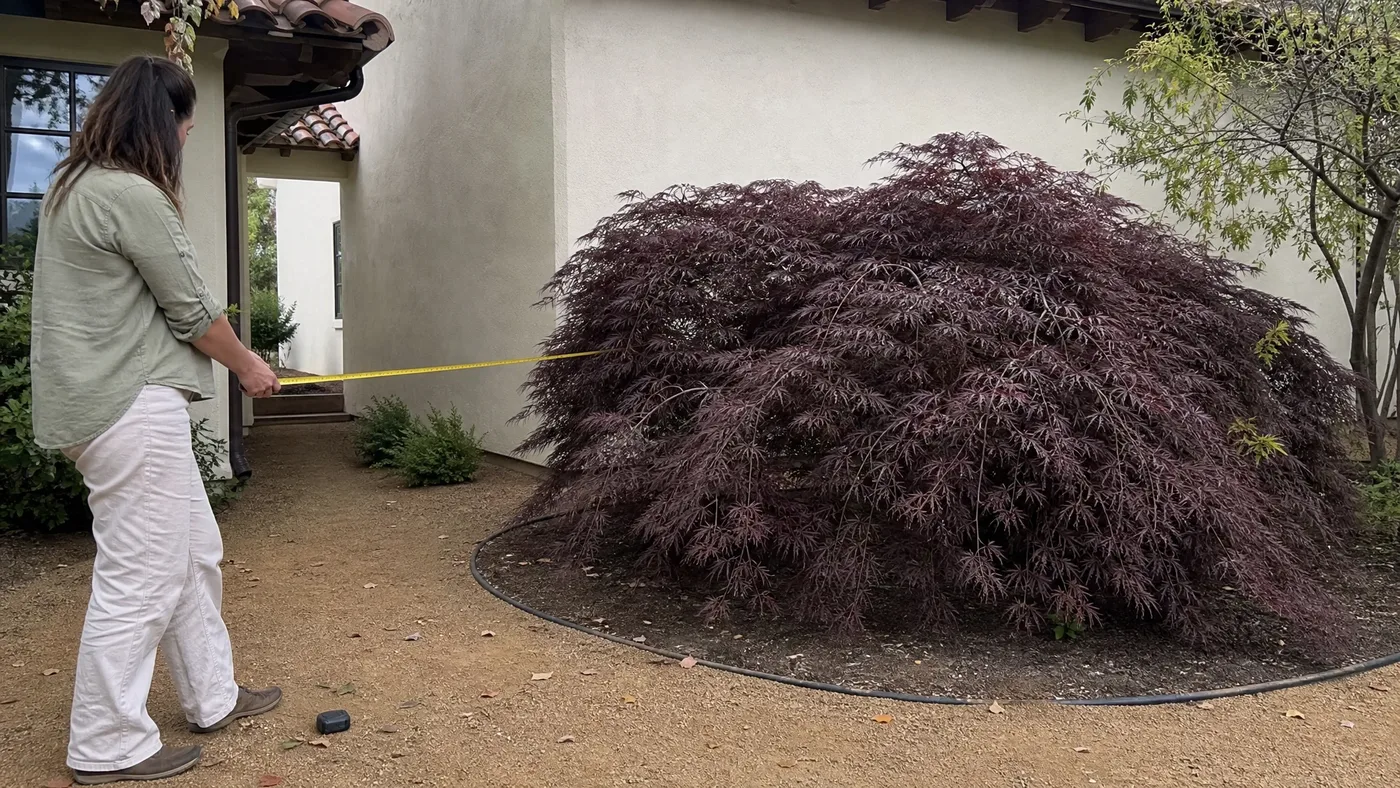
Is Crimson Queen a Dwarf Japanese Maple? What Size to Expect
Ten feet is the number we ask customers to carry home with them, and it is the one the plant tag rarely mentions. Most references put Crimson Queen at roughly 8–10 feet tall and 10–12 feet wide at maturity, which is a good deal more plant than the word "dwarf" suggests.
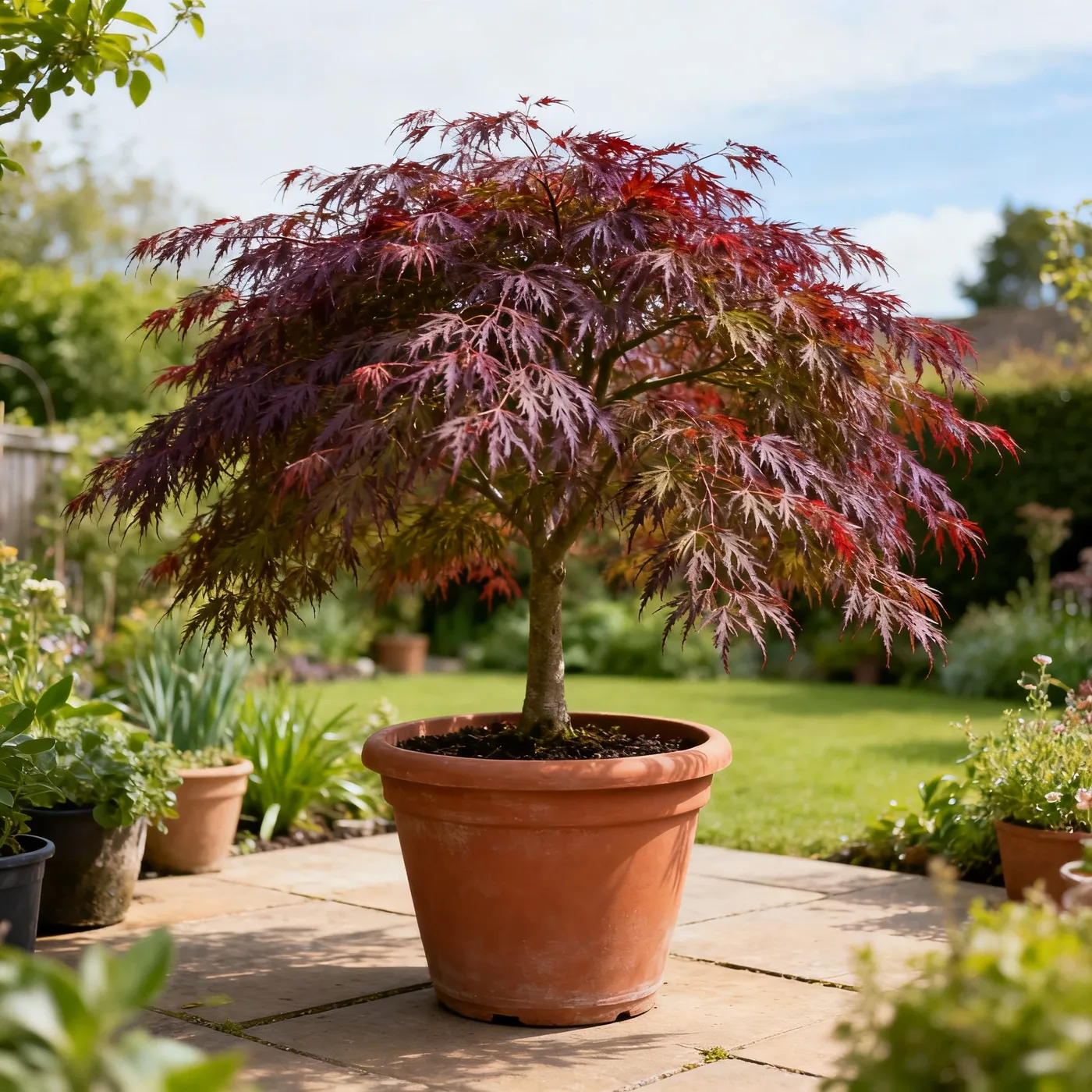
We still remember a customer standing in the field row one October, pointing at a young Crimson Queen no higher than their knee and calling it a little one. It was, that year. It will not stay that way, and the distance between that moment and the mature plant is where most planting regrets begin.
We'll walk you through what the dwarf label means, how tags and young plants mislead, and how Crimson Queen compares with true dwarfs and full-size uprights, then whether a pot holds it back and how to plan its space.
The Myth That Crimson Queen Japanese Maple Stays Tiny
The belief is common and easy to understand, so we will settle it with numbers before anything else.
The figures we give customers are 8–10 feet tall and 10–12 feet wide at maturity. Other heights run from a lower 5–8 feet for both height and spread up to 10 feet tall and slightly wider. Read those figures together and you have a plant that ends somewhere between a large shrub and a small tree. It is never a tiny one.
The timing matters as much as the size. Crimson Queen takes 10–20 years to reach ultimate size, and it is a medium-sized deciduous shrub with an arching habit. "Medium-sized" is the honest phrase. That slow arrival is why the plant looks modest for years and then quietly stops being modest.
If you want the numbers broken down by age, our guide on how big a Crimson Queen Japanese maple gets goes through them. Here we are asking a different question, which is why anyone believed it stayed small in the first place.
What the Dwarf Label Really Means
In the plant trade, "dwarf" has no fixed number behind it, and Crimson Queen is a good example of why that matters.
How Nurseries Use the Word
Among growers the word is a comparison, not a measurement.
Calling a Japanese maple dwarf usually means it is smaller and slower than the upright species, which can reach well past a dozen feet. Set against that, a 10-foot plant reads as dwarf. Crimson Queen is commonly listed as a weeping dwarf Japanese maple with finely dissected burgundy foliage. Both statements are true, and neither says it stays small.
The dissectum, or cutleaf, group earns the label partly through pace. The University of Florida extension notes that a dissectum maple has a slow growth rate that suits residential landscapes. Slow is not the same as limited, and a slow plant simply takes longer to reach the same size.
What We Call It
Our own wording is plainer than the tag.
What we tell customers is that Crimson Queen is a compact weeping maple: small for a maple and mid-sized for a yard. If you need something that stays under a few feet, the word dwarf on a tag is not enough. Ask for the mature height and spread in numbers, and treat a missing number as an answer.
Why Small-Tree Tags Mislead Buyers
Two things work together here: the words on the tag and the size of the plant in the pot.
The tag describes a category. "Small tree," "dwarf" and "compact" all sit comfortably on a plant that ends at 10 feet tall and 12 feet across. None of them is false, and none of them tells you how much lawn or bed the plant will eventually take. A tag that prints a height without a width leaves out the larger of the two numbers, since this cultivar is wider than it is tall.
The pot shows year one. NC State describes growth in the species as slow to moderate, and with 10–20 years to maturity, a plant you carry to the car is a small fraction of the finished shrub. Customers usually ask us whether the plant in the pot is close to its final size, and the answer is that it is nowhere near.
The fix is simple. Judge the plant by its mature measurements, never by what is in front of you at the counter. Our guide to pot sizes and what to look for explains how nursery size relates to the plant you will eventually own.
Crimson Queen Japanese Maple Next to True Dwarf Maples
A real dwarf Japanese maple is a different kind of plant, and the comparison is worth making plainly.
True dwarf maples stay in the range of a few feet. They tuck into a rock garden, a trough or the front of a border and stay there for decades. Crimson Queen at 8–10 feet is a multiple of that, and its branches spread past the width of most beds. We are not listing dwarf cultivar names here, because the yardstick matters more than the list.
A Simple Test Before You Buy
You can apply the same test to any maple, whatever the tag says.
Ask for the mature height and width in feet. If both numbers are a few feet, it is a dwarf. If either is 8 feet or more, it is a landscape plant, and you should place it as one. Crimson Queen passes the second test and fails the first, which is no criticism of the tree. It simply belongs in a different part of the garden.
If you are choosing between maples on size alone, our comparison of Crimson Queen and other Japanese maple varieties lines up the common ones side by side.
Why Crimson Queen Japanese Maple Spreads More Than It Rises
Most buyers plan around height, but for this cultivar the wider number is the one that decides where it goes.
The mature spread of 10–12 feet is larger than the height of 8–10 feet, and a description of 10 feet tall and slightly wider says the same thing in fewer words. The habit is arching and weeping, so the branches fall outward and down rather than climbing. The general dissectum form is mounded too, and the University of Florida figures of about 15 feet tall by 20 feet wide show the same pattern, wider than tall by a third.
Measure From the Trunk Outward
Spread is easier to plan around if you think in radius.
A 12-foot spread means about 6 feet from the trunk in every direction. That is the distance to hold clear of walls, walks, steps and neighboring shrubs. Branch tips on a mature plant sweep low, so a path edge that seems safe at planting can end up brushed by foliage a decade later. Our guide to pruning without ruining the shape covers what can be trimmed back, but it is far kinder to the tree to give it room at the start.
Crimson Queen Japanese Maple Beside Full-Size Uprights
The opposite end of the scale is the upright Japanese maple, and the gap in form is as large as the gap in height.
The species is a variable small tree with a mature height of roughly 13–26 feet. That is a plant you walk beneath, with a trunk and a canopy overhead. Crimson Queen is a plant you walk around. The table below puts the types in one place so you can see where it sits.
| Type | Mature height | Shape |
|---|---|---|
| True dwarf Japanese maple | A few feet | Compact, often tight and slow |
| Crimson Queen | 8–10 feet (spread 10–12 feet) | Weeping, arching, wider than tall |
| Dissectum-type maple (general) | About 15 feet (spread about 20 feet) | Mounded, much wider than tall |
| Upright species | Roughly 13–26 feet | Small tree with a clear trunk |
The table shows why Crimson Queen sits in the middle. It will not disappear in a trough, and it will not shade a patio. It is the right size for a corner, a bed edge or a spot beside a gate, and the wrong size for a narrow strip between a fence and a walkway.
Does a Pot Keep It Small?
Many buyers hope that a container will hold the tree to dwarf size, so we want to settle that directly.
What a Pot Does Control
A pot limits the root volume, and that slows the top growth.
A Crimson Queen in a container grows more slowly and can be kept in scale for a number of years, provided it is watered carefully and repotted when the roots fill the pot. Container plants dry out faster than ground plants, and leaf scorch is a recorded problem in the species, so a pot adds work as well as limiting growth. Our guide to growing it in a container covers the routine.
What It Cannot Change
A pot does not change the tree's genetics.
The potential of the plant is the same, and once the roots go into open ground it will move toward the mature size of 8–10 by 10–12 feet. Some advice says to keep the roots tight to stay small. We would not follow it as a permanent plan, because a root-bound maple is a stressed one. Treat the pot as a holding pattern, not a size setting.
Planning Space for Crimson Queen Japanese Maple
With the findings above, the plan is straightforward: allow for the mature plant, not the one you bring home.
Spacing and Siting
Start with the footprint and work outward from it.
- Allow a clear circle about 12 feet across, which is 6 feet from the trunk to the nearest wall, walk or shrub.
- Allow roughly 10 feet of height above, with no low eaves or overhead wires in the way.
- Remember it takes 10–20 years to fill that space, so you can plant companions nearby and move them as the maple grows.
- Avoid planting where a wide, low canopy would block a window, a path or a view you want to keep.
Light and Soil
Size is only half of siting, and light and soil complete it.
Crimson Queen takes full sun to part shade, and we favor a spot that gets afternoon shade where summers are hot, because that is where leaf scorch shows up. It suits moist but well-drained soil, acid or neutral. A plant that is happy in its position grows toward its mature size at a steady rate, while a struggling one stalls and looks small for the wrong reasons.
Measure the Corner Before You Plant
So, is Crimson Queen a dwarf Japanese maple? Only by comparison with the upright species. In numbers it is a weeping plant of 8–10 feet by 10–12 feet, slow to arrive and wider than it is tall. Plan for the radius, not the height, and treat a pot as a pause rather than a limit.
Crimson Queen Japanese Maple
Nursery-grown Crimson Queen Japanese Maple in sizes from 1 Gallon, shipped to your door.
From $59.97
Shop Now →We remember an old plant at the edge of our rows that, one September, had grown to fill its corner entirely, its branches resting on the ground and its leaves just starting to turn. Everyone who had called it small years before stood and looked at it. Measure the space first, and the plant will fill it as it should. Our growers watch Crimson Queen through the year for new growth in spring, scorch in summer heat and shape in winter, and as a small business we grow and sell top-quality plants.