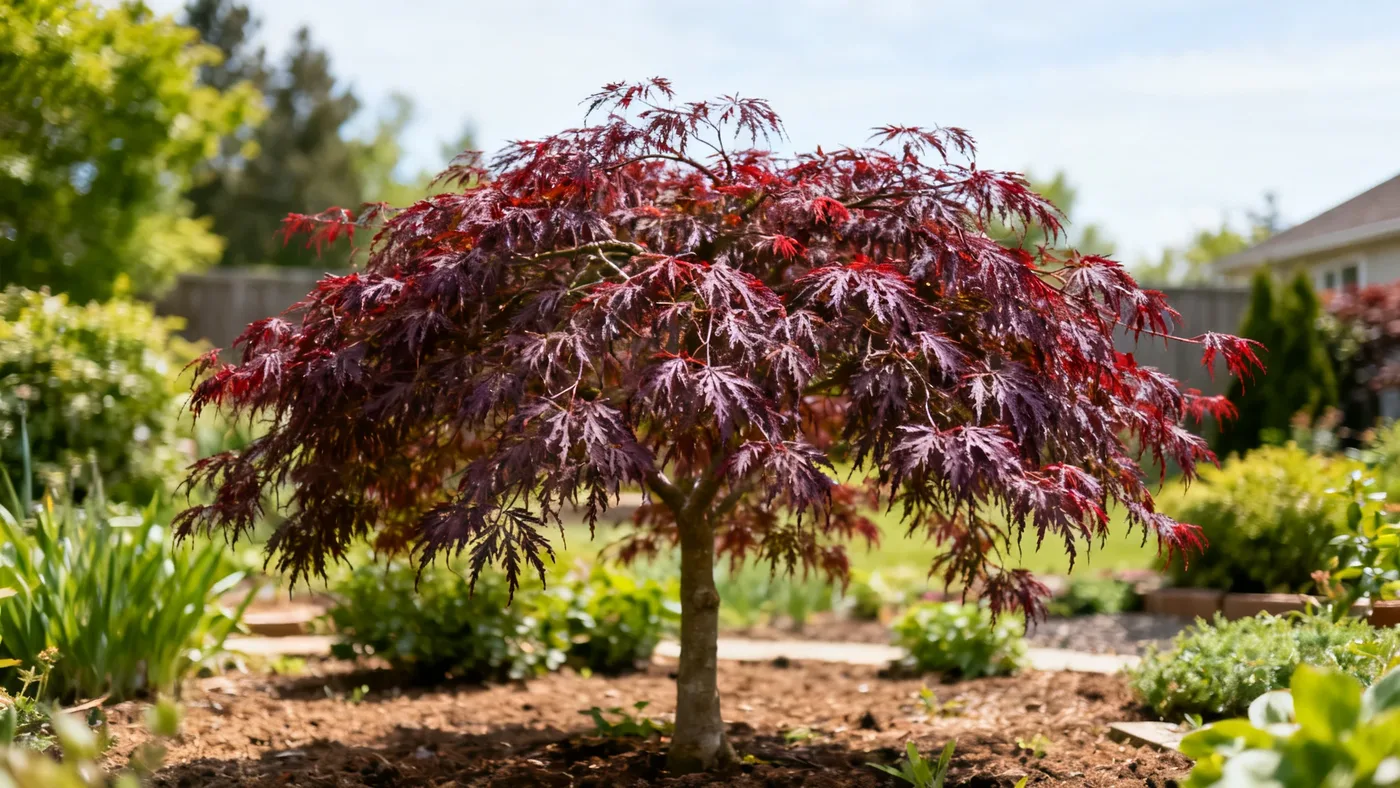
Crimson Queen and Other Japanese Maple Varieties Compared
If you're shopping for a Japanese maple with deep red laceleaf foliage, you'll quickly discover there isn't just one option. The Crimson Queen Japanese Maple draws serious attention for its weeping form and vibrant color, but several other cultivars share similar traits with distinct advantages depending on where you live and what your garden needs.
This guide compares the most popular red laceleaf and weeping Japanese maple varieties so you can choose confidently. We'll cover how they differ in size, growth habit, cold hardiness, and how they perform in real gardens rather than just in the catalog photo.
Comparison Table: Red and Weeping Japanese Maple Cultivars
| Cultivar | Mature Height | Mature Width | Growth Habit | Hardiness | Foliage Color | Leaf Form |
|---|---|---|---|---|---|---|
| Crimson Queen | 8-10 ft | 10-12 ft | Weeping, cascading | Zones 5-8 | Red-purple (spring), crimson (fall) | Finely dissected, lacy |
| Tamukeyama | 8-10 ft (similar) | 10-12 ft (similar) | Weeping, cascading | Zones 5-8 | Red-purple (spring), scarlet (fall) | Finely dissected, lacy |
| Garnet | 6-8 ft | 8-10 ft | Slightly more upright | Zones 5-8 | Deep red (spring), crimson (fall) | Finely dissected, lacy |
| Red Dragon | Variable | Variable | Weeping | Zones 5-8 | Red-purple, may bronze slightly | Finely dissected |
| Inaba Shidare | Variable | Variable | Weeping | Zones 5-8 | Red-purple, may bronze slightly | Finely dissected |
Crimson Queen: The Standard Weeping Form
Crimson Queen is the gold standard for gardeners who want a dramatic red laceleaf maple with a distinctly weeping habit. It reaches 8 to 10 feet tall and 10 to 12 feet wide over 15 to 20 years of growth, with a mature width that typically exceeds its height thanks to the cascading branch structure.
The foliage emerges as a deep red-purple in spring and transforms into brilliant crimson to scarlet red in fall. The leaves are finely dissected with a lacy texture that catches light and looks almost delicate, though the plant is hardy in zones 5 through 8. Some growers extend this to zone 9 with afternoon shade in hot-summer climates to prevent leaf scorch.
Pros:
- Reliably graceful weeping form with minimal pruning needed
- Excellent red color that holds well through the growing season
- Suitable for containers and patio planting as well as in-ground
- Long-lived, often reaching 50 to 100+ years with good siting
- Moderately deer resistant, though browsing varies by region
Cons:
- Slow growth rate (roughly 6 to 12 inches per year) means patience is required
- Requires regular, consistent moisture and is not drought tolerant once dry spells extend
- Vulnerable to verticillium wilt, a soil-borne disease that can be fatal
- Subject to leaf scorch in very hot, dry, windy conditions without afternoon shade
- Low salt tolerance makes it unsuitable near roads treated with de-icing salts
Learn more about caring for Crimson Queen year-round by reading our complete growing guide. For details on how big yours will eventually get, see our guide on mature size.
Tamukeyama: The Closest Alternative
If you visit multiple nurseries shopping for Japanese maple cultivars compared by weeping form and laceleaf foliage, you'll likely see Tamukeyama alongside Crimson Queen. The two are so similar that they're frequently mistaken for each other.
Tamukeyama is a weeping red laceleaf form that reaches roughly the same mature dimensions as Crimson Queen: 8 to 10 feet tall and 10 to 12 feet wide. It has the same finely dissected, lacy leaf texture and emerges in red-purple before turning scarlet red in fall. The hardy range is also zones 5 through 8.
Pros:
- Virtually identical growth habit and foliage appearance to Crimson Queen
- Equally graceful cascading form when mature
- Fall color often described as slightly more vivid scarlet
- Same hardiness range and cultural needs
Cons:
- Availability can be more limited depending on your region and nursery
- Nursery staff may have difficulty distinguishing it from Crimson Queen in the field
- Subject to the same diseases and environmental stresses as Crimson Queen
- If you prefer one specific cultivar, ensure your nursery has labeled it correctly
For most home gardeners, Crimson Queen and Tamukeyama are close enough that the choice comes down to which is available locally and whether you have a personal preference for the nursery growing it.
Garnet: A More Upright Option with the Same Color Palette
Garnet is a Japanese maple cultivar that gives you the red laceleaf qualities many gardeners seek, but with a growth habit that's slightly more upright than Crimson Queen. This makes it useful if you want red dissected foliage but have less horizontal space or prefer a more vertical accent.
Garnet reaches 6 to 8 feet tall and 8 to 10 feet wide at maturity, making it about 2 feet shorter than Crimson Queen on average. Like other types of weeping Japanese maple, Garnet has finely dissected leaves, but the overall branch structure is less dramatically weeping. The deep red spring foliage shifts to crimson in fall.
Pros:
- Smaller and more compact than Crimson Queen, fitting tighter spaces
- Still delivers the red laceleaf aesthetic without the wide cascading spread
- Slightly faster branching in some growing conditions than Crimson Queen
- Same hardiness zones (5-8) and cultural requirements
Cons:
- Less dramatically weeping form means loss of the signature cascading silhouette
- Reduced width at maturity may not suit designs where a wide umbrella of foliage is desired
- Color saturation and fall display are similar but not identical to Crimson Queen
Garnet is an excellent choice if you want red Japanese maple cultivars compared side-by-side with vertical layering priorities, such as for a small foundation planting or mixed border.
Red Dragon, Inaba Shidare, and Other Notable Varieties
Beyond Crimson Queen, Tamukeyama, and Garnet, the Acer palmatum catalog includes several other weeping red laceleaf options. Red Dragon is recognized for its weeping habit and red-purple foliage, which can bronze slightly during intense summer sun or heat stress. Inaba Shidare follows a similar profile with a weeping form and dissected leaves that emerge in red-purple.
Both are hardy in zones 5 through 8 and share the cultural needs of Crimson Queen: rich, well-drained soil, consistent moisture, and afternoon shade in hot-summer climates. Exact mature dimensions for these cultivars vary more widely depending on growing conditions and age, so check with your nursery for specific expectations.
If you're exploring the full range of Japanese maple cultivars compared across the genus, you'll also encounter green-leaf dissectum types like Viridis, which have the same intricate leaf form but lack the red pigment. These offer year-round texture without the color commitment.
Best For: Which Variety Fits Your Garden?
Choose Crimson Queen if you want: A signature weeping specimen with deep red laceleaf foliage, proven performance across zones 5-8, and dramatic color impact as a focal point. It's ideal for partial shade locations, Japanese and zen-style gardens, and poolside or pond-edge planting where the cascading form reflects in water.
Choose Tamukeyama if you want: Nearly identical characteristics to Crimson Queen but prefer to source from a specific grower or have a slight preference for extra scarlet intensity in fall color. It works anywhere Crimson Queen would thrive.
Choose Garnet if you want: Red laceleaf foliage and a Japanese maple look in a more compact, slightly upright form. It fits smaller yards, foundation plantings, and layered borders where a wide weeping spread would overwhelm the space.
Choose Red Dragon or Inaba Shidare if you want: To explore less-common cultivars within the dissectum weeping group. Confirm mature dimensions with your local nursery, as these are less standardized in the trade than Crimson Queen or Garnet.
Choose a green-leaf dissectum variety if you want: The intricate lacy texture without the color maintenance and no risk of summer leaf scorch in extreme heat.
Hardiness and Climate Fit
All the primary red laceleaf varieties covered here share the same hardiness zone range: zones 5 through 8. Some growers successfully push certain cultivars into zone 9, but this requires afternoon shade in hot-summer regions to prevent leaf scorch.
Zone 5 gardeners should expect that young plants may experience winter dieback during severe cold spells, particularly in their first few years. Once established, mature trees tolerate the cold reliably. Zone 8 gardeners in hot climates should prioritize afternoon shade and consistent soil moisture to keep foliage healthy through summer.
Soil and Water Needs Across Varieties
Whether you choose Crimson Queen, Garnet, or another dissectum cultivar, the soil and water profile remains consistent across these types of weeping Japanese maple. All require:
- Rich, well-drained loam high in organic matter
- Slightly acidic to neutral soil pH (about 5.5 to 6.5)
- Regular, consistent moisture without waterlogging
- Afternoon shade in hot-summer climates to prevent leaf scorch
- Protection from salt spray and de-icing salt drift
The growth rate for all these cultivars is slow, roughly 6 to 12 inches per year, so spacing decisions at planting should account for mature width, not current size.
Sourcing and Container Growing
Nursery-grown Japanese maple specimens are typically sold in quart, #1, or #3 containers. Crimson Queen is more widely available in most regions than specialty cultivars like Red Dragon or Inaba Shidare. If you have your heart set on a less common variety, expect to wait for availability or work with specialty nurseries.
All these varieties suit container and patio planting provided the container has good drainage. Containerized trees in zones 5-6 may need extra winter protection for the roots, since containers offer less insulation than in-ground soil.
Quick Reference: Red Laceleaf Japanese Maple Cultivars
| Decision Criteria | Best Choice | Second Choice |
|---|---|---|
| Most dramatic weeping form | Crimson Queen or Tamukeyama | Red Dragon |
| Compact space (under 8 ft wide) | Garnet | Select Inaba Shidare specimens |
| Proven availability nationwide | Crimson Queen | Garnet |
| Vibrant fall color priority | Crimson Queen or Tamukeyama | Garnet |
| Specimen/focal point planting | Crimson Queen or Tamukeyama | Red Dragon |
| Zone 5 colder microclimates | Crimson Queen | Garnet |
| Hot zone 8 with shade available | Crimson Queen | Tamukeyama |
| Container or patio planting | Garnet or Crimson Queen | Inaba Shidare |